


The Tailor-Made Guide to Things to Do in Clermont Ferrand France

Author: Barry Pickard
Hi, I'm Barry, the owner of Tailor-Made Itineraries and I have been designing bespoke self-guided tours for adventurous and curious travellers since 2015. I am a history graduate with a passion for travel.
I created this blog to inspire curious travellers and share the experiences behind my bespoke itinerary designs — giving you a flavour of what is possible, and the confidence to reach out and make it happen.
The first thing that hits you in Clermont-Ferrand isn’t a smell of coffee or fresh bread — it’s the mineral, almost metallic scent of rain on warm volcanic stone, rising up from the black lava streets after a summer shower. Add the clatter of trams swinging round Place de Jaude, café chatter spilling onto pavement tables, and the sudden hush that falls the moment you step through the cathedral’s west doors into cool, dark stone silence — and you’ve got a city that announces itself to every one of your senses before you’ve even opened a guidebook.
So, what is there to do in Clermont-Ferrand, France? In short: more than most travellers expect from a city this size. Between a cathedral built from black volcanic stone, an entire museum dedicated to Michelin, a UNESCO-listed Romanesque basilica, and volcanoes on the doorstep, you could easily fill two or three days here — and in this guide to things to do in Clermont Ferrand France, I’ll walk you through the very best of it.
I’m Barry, and I’ve been designing bespoke, self-guided itineraries around places exactly like this since 2015 — history graduate, lifelong traveller, and someone who has actually walked every street I’m about to describe. Nothing here is scraped together from other websites; everything below comes from time I’ve spent on the ground in Clermont-Ferrand, working out which sights are genuinely worth your limited holiday hours and which you can happily skip.

If you’re the kind of independent traveller who’d rather plan your own route than follow a group flag, you’re in exactly the right place. So settle in — this one’s worth reading to the end.
Contents

Don’t forget that Tailor-Made Itineraries specialises in creating expert, bespoke self-guided tours. If you'd like to explore Clermont Ferrand as part of a professionally crafted itinerary, get in touch — we'd love to design something built around you.
Disclosure: This post contains affiliate links. Regardless of this, please be advised that all opinions expressed in this blog post are genuine and authentically my own.

Ready to dive in? Let’s start with a little background on this remarkable city.
About Clermont-Ferrand
Clermont-Ferrand sits at the heart of the Auvergne and is one of France’s most distinctive cities, shaped by its volcanic geography and deep historical roots. Much of the old town is built from dark basaltic lava stone, giving the streets and monuments a dramatic, almost sculptural appearance. The city lies at the foot of the Chaîne des Puys, a UNESCO‑listed chain of dormant volcanoes, with the iconic Puy de Dôme rising above the skyline. Its origins stretch back to the Gauls, who founded the settlement of Nemossos before it became the Roman city of Augustonemetum. Clermont and neighbouring Montferrand developed as rival medieval towns until Cardinal Richelieu ordered their union in 1630, creating the dual‑heritage city visitors explore today.

Modern Clermont-Ferrand blends this heritage with a strong industrial identity, most famously as the birthplace of Michelin, whose presence shaped the city’s growth from the late 19th century onwards. Today, Clermont-Ferrand feels lively and youthful thanks to its university population, cultural institutions, and café‑lined squares. Its compact centre makes it easy to explore on foot, with plenty of things to see in Clermont Ferrand packed into a small area, — though planning the most efficient route between its historic and modern districts takes a little insider knowledge. The volcanic landscape frames every viewpoint, giving the city a unique atmosphere—urban yet deeply connected to the rugged Massif Central.

Here’s where it gets really good:
Things to Do in Clermont Ferrand France
Cathédrale Notre-Dame-de-l'Assomption
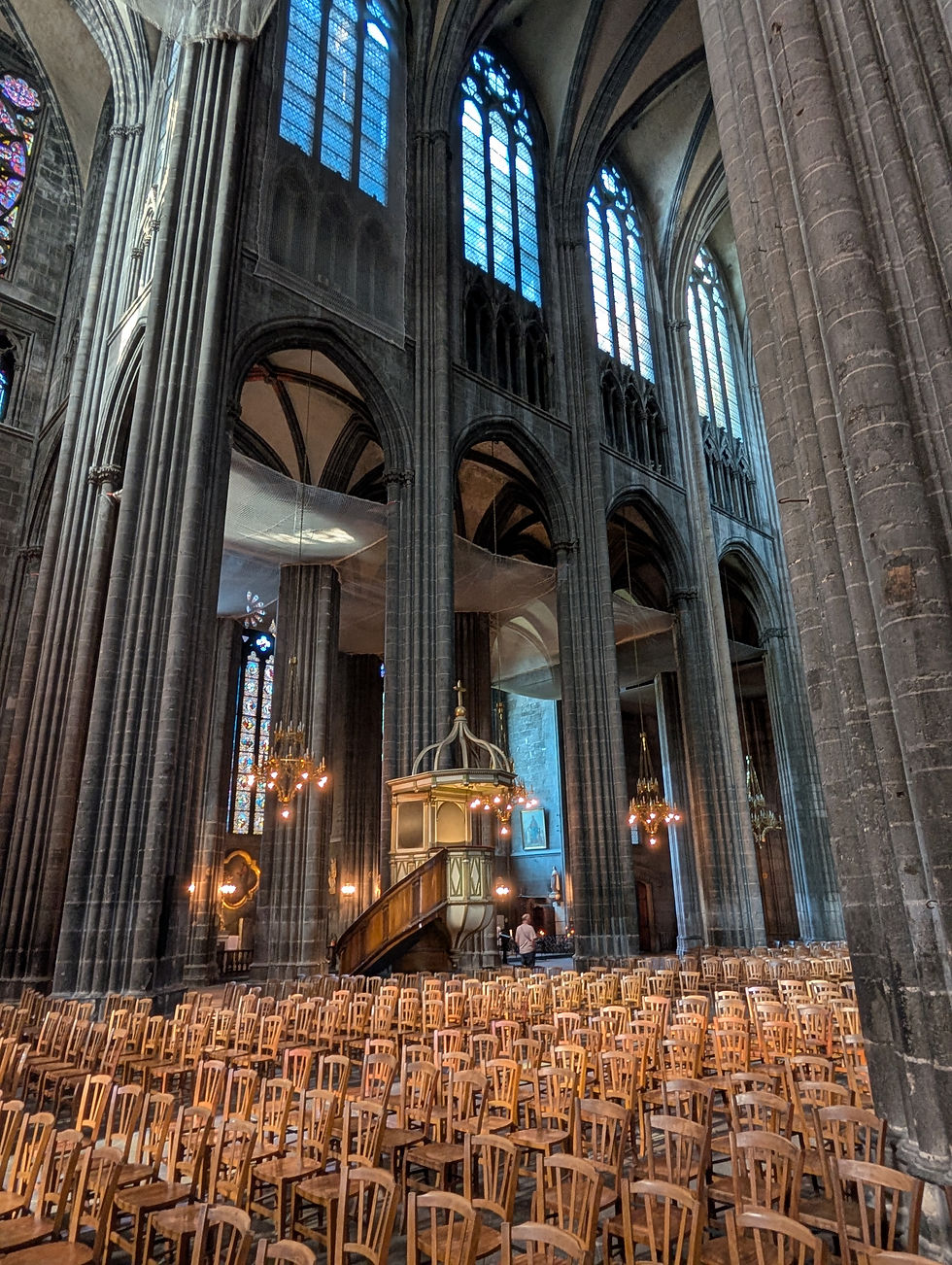
Clermont-Ferrand’s cathedral is one of France’s most striking Gothic monuments, instantly recognisable for its construction in deep black volcanic stone quarried from nearby Volvic. Begun in the 13th century and later enhanced by architect Viollet‑le‑Duc, its twin spires rise nearly 90 metres above the city, creating a dramatic silhouette against the volcanic horizon. Inside, the cathedral houses an exceptional collection of medieval stained‑glass windows—among the best preserved in France—which cast jewel‑toned light across the dark stone interior. The building stands on the Clermont mound, the historic heart of the old town, and has long served as a symbol of the city’s religious and civic identity. Its portals, chapels, and sculptural details reward slow exploration, while the surrounding streets offer atmospheric views of the cathedral from different angles.

Tailor-Made Top Tip: Walk around the cathedral at different times of day—the contrast between sunlight and the black lava stone makes for superb photography.

Cathédrale Notre-Dame-de-l'Assomption Cathédrale Notre-Dame-de-l'Assomption Cathédrale Notre-Dame-de-l'Assomption Cathédrale Notre-Dame-de-l'Assomption Cathédrale Notre-Dame-de-l'Assomption Cathédrale Notre-Dame-de-l'Assomption Cathédrale Notre-Dame-de-l'Assomption
Musée de la Résistance
The Musée de la Résistance offers a thoughtful and moving exploration of the Auvergne’s role during the Second World War, particularly the activities of the French Resistance. Exhibits typically include personal testimonies, clandestine documents, propaganda materials, and objects used by local resistance fighters. Clermont-Ferrand was an important centre for underground networks, and the museum helps visitors understand how ordinary citizens organised themselves against occupation While not a large museum, it is dense with information.
Musée de la Résistance Musée de la Résistance Musée de la Résistance Musée de la Résistance Musée de la Résistance Musée de la Résistance Musée de la Résistance
Tailor-Made Top Tip: After visiting the museum, you can take some time relaxing in the Parc Beaulieu, which is a peaceful greenspace that sits along the Tiretaine river.

Place de Jaude
Place de Jaude is Clermont-Ferrand’s main square and a lively focal point for both locals and visitors. This broad, modernised esplanade is framed by shops, cafés, and cultural venues, making it one of the most fun things to do in Clermont Ferrand when you just want to pause, people-watch, and soak up the atmosphere between sightseeing stops. At its centre stands the dramatic equestrian statue of Vercingétorix, created by Frédéric Auguste Bartholdi—the same sculptor behind the Statue of Liberty. The Gallic leader is depicted raising his sword in defiance, commemorating his historic resistance against Julius Caesar.

Place de Jaude Place de Jaude Place de Jaude Place de Jaude
If you enjoy this kind of curated travel insight, you can subscribe to receive future guides and inspiration.
Muséum d'histoire naturelle Henri-Lecoq
The Henri-Lecoq Natural History Museum is one of Clermont-Ferrand’s most intriguing cultural institutions, offering a rich blend of geology, botany, zoology, and regional heritage. Its collections trace the natural history of the Auvergne, from volcanic formations and mineral specimens to preserved flora and fauna. The museum’s origins date back to the 19th century, and its displays reflect both scientific curiosity and the region’s unique geological identity. Visitors can learn about the Chaîne des Puys, the Massif Central, and the biodiversity shaped by centuries of volcanic activity.
Muséum d'histoire naturelle Henri-Lecoq Muséum d'histoire naturelle Henri-Lecoq Muséum d'histoire naturelle Henri-Lecoq Muséum d'histoire naturelle Henri-Lecoq Muséum d'histoire naturelle Henri-Lecoq Muséum d'histoire naturelle Henri-Lecoq
Tailor-Made Top Tip: Combine your visit with nearby Jardin Lecoq—the museum and garden complement each other beautifully.
Jardin Lecoq
Jardin Lecoq is Clermont-Ferrand’s most elegant public garden, offering a peaceful green escape in the centre of the city. Designed in the 19th century, it features manicured lawns, flowerbeds, ponds, and shaded pathways that invite slow wandering. Sculptures and ornamental features are dotted throughout, while seasonal plantings ensure the garden feels vibrant year‑round.
Jardin Lecoq Jardin Lecoq Jardin Lecoq Jardin Lecoq Jardin Lecoq
Basilique Notre-Dame du Port
A masterpiece of Romanesque architecture, the Basilica of Notre-Dame du Port is one of Clermont-Ferrand’s most important historic sites and a UNESCO World Heritage location as part of the Routes of Santiago de Compostela. Built in the 12th century, it is renowned for its harmonious proportions, sculpted portal, and distinctive pyramidal apse decorated with rosettes. The basilica’s warm stone contrasts beautifully with the darker volcanic buildings elsewhere in the city. Its location in the Port district places it within one of Clermont’s most characterful neighbourhoods, where narrow streets and traditional façades evoke centuries of pilgrimage and devotion.


Basilique Notre-Dame du Port Basilique Notre-Dame du Port Basilique Notre-Dame du Port Basilique Notre-Dame du Port Basilique Notre-Dame du Port Basilique Notre-Dame du Port Basilique Notre-Dame du Port Basilique Notre-Dame du Port Basilique Notre-Dame du Port Basilique Notre-Dame du Port
L'Aventure Michelin
L’Aventure Michelin is an engaging and modern museum dedicated to the history, innovation, and global impact of the Michelin company, founded in Clermont-Ferrand in 1889. The museum blends interactive exhibits, historic vehicles, archival materials, and multimedia displays to tell the story of how Michelin evolved from a local rubber manufacturer into a worldwide leader in tyres, mobility, and mapping. Visitors can explore early advertising campaigns, including the iconic Bibendum figure, learn about technological breakthroughs, and see how Michelin’s innovations shaped transport across the 20th and 21st centuries. The museum also highlights the company’s deep connection to Clermont-Ferrand, illustrating how industrial growth influenced the city’s development.

Tailor-Made Top Tip: Go online and book a timed ticket in advance, since this attraction can get booked up.
L'Aventure Michelin L'Aventure Michelin L'Aventure Michelin L'Aventure Michelin L'Aventure Michelin L'Aventure Michelin L'Aventure Michelin L'Aventure Michelin
Musée d'Art Roger Quilliot
Located in the historic district of Montferrand, the Musée d’Art Roger Quilliot is Clermont-Ferrand’s principal fine arts museum. Housed in a former convent redesigned with contemporary architectural elements, it offers a spacious and atmospheric setting for its diverse collections. Exhibits range from medieval religious art and Renaissance works to modern paintings, sculpture, and decorative arts.

Musée d'Art Roger Quilliot Musée d'Art Roger Quilliot Musée d'Art Roger Quilliot Musée d'Art Roger Quilliot Musée d'Art Roger Quilliot Musée d'Art Roger Quilliot Musée d'Art Roger Quilliot Musée d'Art Roger Quilliot Musée d'Art Roger Quilliot Musée d'Art Roger Quilliot Musée d'Art Roger Quilliot
Ancienne Collégiale Notre-Dame de Prospérité de Montferrand
This former collegiate church is one of Montferrand’s lesser‑known architectural treasures, offering insight into the district’s medieval religious heritage. While no longer functioning as an active church, the building retains many of its historic features, including Romanesque and Gothic elements that reflect its long evolution. Its presence highlights Montferrand’s importance as an independent town before its union with Clermont in the 17th century.

Tailor-Made Top Tip: Check opening hours in advance—access can vary depending on events and restoration work.
Ancienne Collégiale Notre-Dame de Prospérité de Montferrand Ancienne Collégiale Notre-Dame de Prospérité de Montferrand Ancienne Collégiale Notre-Dame de Prospérité de Montferrand Ancienne Collégiale Notre-Dame de Prospérité de Montferrand Ancienne Collégiale Notre-Dame de Prospérité de Montferrand Ancienne Collégiale Notre-Dame de Prospérité de Montferrand Ancienne Collégiale Notre-Dame de Prospérité de Montferrand Ancienne Collégiale Notre-Dame de Prospérité de Montferrand Ancienne Collégiale Notre-Dame de Prospérité de Montferrand Ancienne Collégiale Notre-Dame de Prospérité de Montferrand
If you enjoy this kind of curated travel insight, you can subscribe to receive future guides and inspiration.
Travelling to Clermont-Ferrand
Clermont-Ferrand is well connected and surprisingly easy to reach, whether you’re arriving from elsewhere in France or travelling internationally to visit Clermont Ferrand for the first time. The city’s main transport hub is Clermont-Ferrand Gare, served by frequent TER regional trains and direct long‑distance services. Travellers coming from Paris can reach Clermont-Ferrand in around 3–3.5 hours, most conveniently from Paris-Bercy, with several direct trains running daily. Lyon, Limoges, and other major cities in central France also have reliable rail links, making Clermont-Ferrand an accessible stop on wider itineraries across the Massif Central or Auvergne.
If you’re flying, the nearest airport is Clermont-Ferrand Auvergne Airport, located just east of the city. A small but efficient terminal, it offers domestic connections and limited European routes. For those driving, Clermont-Ferrand sits at the crossroads of the A71, A75, and A89 motorways, offering scenic approaches through volcanic landscapes and rolling countryside. Once you arrive, the city’s compact layout and excellent public transport make getting around simple, whether you’re exploring the historic centre, heading to Montferrand, or venturing out towards the Chaîne des Puys.

But here’s the catch:
How to Plan Your Time in Clermont-Ferrand
Clermont-Ferrand is a wonderfully walkable city, but planning your time here isn’t always as straightforward as it first appears. The historic centre, Montferrand, and the cultural districts each have their own “natural groupings” of attractions — clusters that make sense to explore together — yet the volcanic geography, split‑city layout, and varied opening hours mean that creating a smooth, efficient plan takes more thought than most visitors expect.
For example, the cathedral, Place de Jaude, and Jardin Lecoq form an easy, compact grouping ideal for a half‑day of relaxed wandering, while Montferrand’s museums and medieval streets naturally pair together but require a short tram ride. Indoor attractions like L’Aventure Michelin and the Musée de la Résistance are perfect for poor weather days, whereas outdoor spaces such as Parc Beaulieu or the viewpoints around the city reward clear skies.
Most travellers try to combine these elements themselves, but quickly discover that sequencing, distances, and seasonal variations make DIY planning surprisingly tricky. If you’d prefer a seamless experience built around your interests, energy levels, and travel style, you can have an expert do the thinking for you.
I create a limited number of bespoke itineraries each month to ensure every trip is properly tailored, so if you’re considering it, it’s always worth getting in touch early. Click here to enquire about a custom Clermont-Ferrand itinerary.

Still have questions? I’ve got you covered:
Quick Questions Answered
What is Clermont-Ferrand, France known for? Clermont-Ferrand is known for its dramatic black‑lava cathedral, its volcanic landscape including the Chaîne des Puys, and being the historic home of Michelin.
Where is Clermont-Ferrand in France? Clermont-Ferrand is located in central France, in the Auvergne region, at the foot of a UNESCO‑listed chain of dormant volcanoes.
Is Clermont-Ferrand worth visiting? Yes—its volcanic scenery, striking architecture, excellent museums, and lively cultural atmosphere make it a rewarding and distinctive French city break.
How many days do you need in Clermont-Ferrand? Two to three days is ideal, giving enough time to explore the historic centre, Montferrand, and the surrounding volcanic landscapes.
Basilique Notre-Dame du Port Basilique Notre-Dame du Port Basilique Notre-Dame du Port
What is the best time of year to visit Clermont-Ferrand? Spring and early autumn offer the most pleasant weather, with clear views of the volcanoes and comfortable temperatures for city exploring.
Is Clermont-Ferrand easy to get around? Yes—the city is compact, walkable, and supported by an efficient tram and bus network.
What food is Clermont-Ferrand known for? The region is famous for hearty Auvergne cuisine, including cheeses like Saint-Nectaire and local dishes such as truffade and aligot.
Can you visit the Puy de Dôme from Clermont-Ferrand? Absolutely—the panoramic summit is easily reached via the Panoramique des Dômes train, making it one of the area’s most popular half‑day trips.
Cathédrale Notre-Dame-de-l'Assomption Cathédrale Notre-Dame-de-l'Assomption Cathédrale Notre-Dame-de-l'Assomption
Is Clermont-Ferrand a good base for exploring the Auvergne? Yes, its central location and strong transport links make it an excellent base for visiting nearby volcanoes, lakes, and historic towns.
Is Clermont-Ferrand safe for tourists? Yes—like most French cities, Clermont-Ferrand is generally safe for visitors, though it’s sensible to take normal precautions with belongings in busy spots like Place de Jaude and the train station.
Do you need a car in Clermont-Ferrand? No—the historic centre and Montferrand are both walkable, and the tram network covers the rest, so a car isn’t necessary unless you’re planning to explore further into the Auvergne countryside.
Is Clermont-Ferrand expensive to visit? It’s generally more affordable than Paris or Lyon, with reasonably priced accommodation, food, and public transport, making it a good option for budget-conscious independent travellers.

Conclusion
Clermont-Ferrand rewards travellers who take their time with it — the volcanic stone, the split personality of Clermont and Montferrand, and quiet surprises like the Ancienne Collégiale all add up to a city that feels genuinely different from anywhere else in France. Whatever mix of history, nature, and culture you’re chasing, this guide to things to do in Clermont Ferrand France should give you a solid starting point for planning your own visit. And if a fully planned, expert-designed itinerary sounds more appealing than working it all out yourself, you know where to find me.
Have you been to Clermont-Ferrand, or is it on your list — drop a comment below and let us know what you’d add to this guide!
Jardin Lecoq Jardin Lecoq Jardin Lecoq
Clermont Ferrand Hotels
Clermont-Ferrand offers an excellent range of accommodation, from elegant historic stays to modern business hotels and budget-friendly options. Each neighbourhood offers a different experience, and choosing the right base can shape how you explore the city. Whether you prefer a polished spa hotel, a mid‑range base close to transport links, or a simple and affordable room, Clermont-Ferrand offers a style of stay to suit every itinerary.
Luxury – Hôtel Littéraire Alexandre Vialatte
A stylish literary-themed hotel with panoramic rooftop views over the cathedral and volcanic skyline. Perfect for visitors who want design-forward comfort in a central location.
A modern, upscale hotel right on Place de Jaude, with spacious rooms and excellent access to shops, restaurants, and tram connections. Perfect for visitors who want convenience and contemporary comfort.
Mid‑Range – Kyriad Prestige Clermont-Ferrand Centre
A popular mid‑range option with modern rooms, good amenities, and a location close to the city’s main cultural attractions. Great for travellers who want comfort without the luxury price tag.
Great Value – Hôtel Albert Elisabeth
A welcoming, great‑value hotel near Clermont-Ferrand Gare, offering clean rooms, warm service, and easy access to both the historic centre and transport connections. Ideal for travellers seeking affordability without compromising on convenience.
Great Value – Hôtel Beaulieu
A simple, well‑located option close to Chamalières and Parc Beaulieu, offering a peaceful base for exploring both the city and nearby green spaces.

Related Blog Posts
If you would like more information on Auvergne-Rhône-Alpes region and how to visit these locations, please view the Tailor-Made Itineraries posts below:
Don’t forget that Tailor-Made Itineraries specialises in creating expert, bespoke self-guided tours. If you'd like to explore Clermont Ferrand as part of a professionally crafted itinerary, get in touch — we'd love to design something built around you.
Tailor-Made Itineraries posts every two weeks, and you can subscribe to the latest blog and newsletter here. Until then, happy reading and safe travels.
Barry
Contact Me: tailoritineraries@gmail.com
Tailor-Made Itineraries creates one-of-a-kind bespoke self-guided travel itineraries for adventurous and curious travellers.
These self-guided tours deliver a personalised and exciting holiday experience that takes the effort out of trip planning.
Clermont Ferrand Map


Comments