


The Tailor-Made Guide to Art Nouveau and Art Deco Cities Around the World

Author: Barry Pickard
Hi, I'm Barry, the owner of Tailor-Made Itineraries and I have been designing bespoke self-guided tours for adventurous and curious travellers since 2015. I am a history graduate with a passion for travel.
I created this blog to show, through my own adventures, how you can have an incredible travel experience as an independent traveller, giving you the information to navigate the world with confidence.
Contents
Close your eyes for a second and picture this: you’re standing on a rain-damp street in Riga, Latvia, your neck craned upward toward a six-storey facade where stone maidens hold up the balconies, their carved faces half-hidden beneath writhing floral tendrils. The morning smells of coffee drifting from a bakery below, mixed with the faint mineral scent of old granite. Somewhere in the distance, a tram bell rings twice. You’re not in a museum — this is just a Tuesday morning in a residential neighbourhood. And everywhere you look, the buildings are extraordinary.

What are the best cities in the world to see Art Nouveau and Art Deco architecture? I’ve spent years trying to answer exactly that question — and this guide is where all that research, all those early morning walks, and all those happy hours photographing iron railings and tiled doorways finally comes together.

I’m Barry Pickard, a history graduate and the owner of Tailor-Made Itineraries, where since 2015 I’ve been designing bespoke self-guided tours for independent travellers who want more than just the standard highlights. I’ve always been drawn to architecture — not just as a backdrop to travel, but as the story itself. And when it comes to Art Nouveau and Art Deco, there’s no shortage of story. These are movements that changed how cities looked, how homes felt, and what everyday objects could be. The debate around Art Nouveau vs Art Deco — organic curves versus geometric boldness, natural forms versus machine-age modernity — is one that still sparks conversation the moment you step inside a beautifully preserved building.
Here’s the thing: I haven’t just read about these places. I’ve walked the length of Alberta Iela in Riga in the cold, stood in the stained-glass glow of René Lalique’s work in a Jersey church, and felt genuinely emotional returning to the abandoned Art Deco swimming pool in Aberdeen where I learnt to swim as a child. This isn’t armchair travel writing — every word in this guide is based on my own experience.

What you’ve found here is a comprehensive guide that brings together my individual deep-dive posts on the world’s finest Art Nouveau and Art Deco destinations — Helsinki, Brussels, Riga, Detroit, Bilbao, Glasgow, Jersey, and more — all in one place. Whether you’re planning your first architecture-focused trip or you’re an experienced independent traveller looking to add a new dimension to your itinerary, you’re in exactly the right place. And if you stick with me to the end, you’ll also find a bucket list of the places I haven’t visited yet but am already itching to explore.
So, if you’re the kind of traveller who slows down to read the plaque on a building, who’d rather spend a morning in a beautifully preserved house museum than in a queue for a theme park — welcome. You’re among friends. Let’s get into it.
Don’t forget that Tailor-Made Itineraries delights in creating bespoke self-guided tours. So, if visiting any of these Art Nouveau and Art Deco cities appeals to you, reach out to me by email. I would be more than happy to design a self-guided tour around your requirements incorporating these architectural masterpieces.

How to Use This Guide
This post pulls together the most architecturally significant Art Nouveau and Art Deco locations I’ve visited over the years. Each section summarises my personal impressions, the history of the site, and what travellers can expect today.
A Brief History of Art Nouveau and Art Deco
Art Nouveau architecture and design emerged in the late 19th century as a decorative movement defined by organic, flowing shapes, floral motifs, curved stonework, and an emphasis on craftsmanship. It often rejected historical revival styles in favour of nature-inspired forms, unifying architecture, decorative arts, and interior design into a single composition.

Art Deco followed in the early 20th century, embracing geometric patterns, symmetry, modern materials, and streamlined forms. Where Art Nouveau flourished through curves and naturalism, the Art Deco style celebrated the Machine Age: sharp lines, chrome, bold colours, and rising verticality. Together, these styles represent Europe’s transformation from the romanticism of the Belle Époque to the confident modernity of the interwar years. And while Art Nouveau designs tended toward the handcrafted and the botanical, Art Deco looked toward the bold and the built — a distinction I’ve felt physically standing between an Art Nouveau doorway in Brussels and a Detroit skyscraper lobby.
How to Plan an Architectural Trip
When travelling to cities rich in Art Nouveau or Art Deco, I’ve found it helpful to map out the key districts before arriving. Many buildings are tucked into residential neighbourhoods, so planning walking routes and checking museum hours in advance saves a lot of time. Trams and buses are invaluable in larger cities, but the best way to appreciate ornamentation is always on foot.
Key Characteristics to Look For
Art Nouveau buildings usually reveal themselves through curved lines, floral details, mythological figures, stained glass, and ironwork inspired by vines or water. Art Deco, by contrast, emphasises verticality, geometry, sunbursts, stylised flowers, zigzags, and polished materials like marble or metal — and the same confident geometry you see in Art Deco art of the period, from posters to jewellery, carries directly into the architecture. When I travel, I like to keep a small checklist — once you start noticing the patterns, entire streets come alive.
But here’s the best part: you don’t need an architecture degree to appreciate any of this. All you need is to know what to look for — and that’s exactly what the sections below are here to help with.
Art Nouveau and Art Deco Cities
Helsinki, Finland
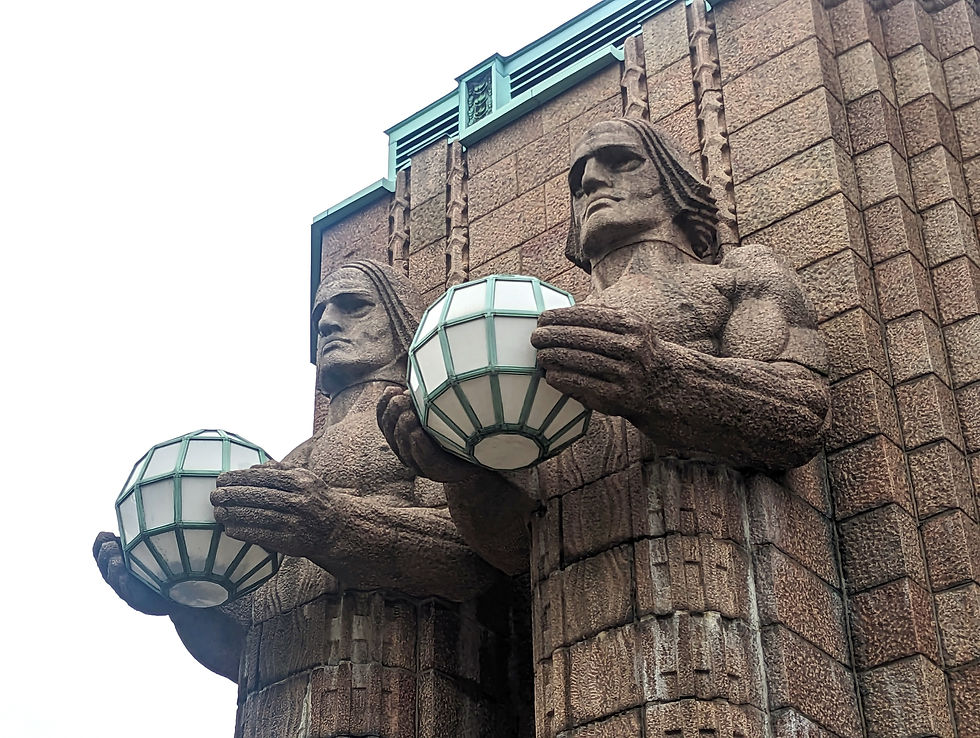
When I explored Helsinki’s neighbourhoods—particularly Katajanokka, Kruununhaka, Ullanlinna, and Etu‑Töölö—I was struck by the quiet confidence of its Jugend architecture. Jugend, Finland’s version of Art Nouveau, blends natural motifs with rugged Finnish granite, creating façades that feel both earthy and elegant. Buildings like Kallio Church, the National Museum, Jugend Hall, and the majestic Helsinki Central Railway Station show how this style shaped the city’s architectural identity.

Walking the streets, I found Helsinki’s Jugend buildings refreshingly understated—less ornamental than their Parisian or Brussels counterparts, but just as expressive. Entire districts are filled with soft curves, carved stone faces, and whimsical details, and with more than 600 Jugend buildings, Helsinki is one of Europe’s richest destinations for this architectural period.

Brussels, Belgium
When I visited Brussels, I spent my days moving between some of the city’s most remarkable house museums. Stepping inside places like the Horta Museum, Van Buuren Museum, and the Villa Empain, I experienced first hand how Art Nouveau and Art Deco shaped private life in the early 20th century. The tram system made it easy to explore these elegant residential neighbourhoods.
Beyond the private homes, Brussels is simply one of the greatest Art Nouveau cities in the world. During my visit, I also spent time at the Musées Royaux des Beaux-Arts de Belgique, where the architecture blends beautifully with its collections. Although not exclusively Art Nouveau or Deco, its elegant interiors and sculpture halls complement a design‑focused trip and offer a deeper cultural context for the styles flourishing in Brussels at the turn of the century.
Riga, Latvia
Riga left a lasting impression on me with its extraordinary Art Nouveau district—the largest concentration of the style anywhere in Europe. Walking along Alberta Iela felt like stepping into a sculptural gallery of faces, figures, and swirling motifs. The Riga Art Nouveau Museum offered a beautifully preserved interior that helped me understand how the style translated into everyday living spaces.

I found Riga perfect for slow exploration. Nearly every block in the Centrs neighbourhood reveals another architectural treasure, and because the area is compact, you can take your time studying the façades and photographing the wonderful details.
Detroit, USA
Detroit surprised me with some of the finest Art Deco skyscrapers I’ve ever seen. When I visited the Fisher Building, its marble-clad lobby and geometric ornamentation felt like walking into a 1920s cathedral of industry. My blog post also covered Michigan Central, which at the time was undergoing transformation—but today, the building has been fully restored and is open once again, making it one of the most exciting Deco revivals in the United States.

Beyond these icons, Detroit boasts numerous Art Deco buildings along Woodward Avenue, including the Guardian Building. The Art Deco style architecture of these buildings is made all the more remarkable by the city’s ongoing revitalisation — a rewarding destination for fans of early‑20th‑century design.
Bilbao, Spain
In Bilbao’s Casco Viejo district, I found two standout examples of early‑20th‑century architecture: Erriberako Merkatua (La Ribera Market) and La Concordia Station. The market’s elegant metalwork and stained-glass touches combine function and style, while La Concordia’s Art Nouveau façade remains one of the most attractive railway stations in Spain. Both are easy to reach on foot while exploring the old town.

Although Bilbao is most famous for contemporary landmarks like the Guggenheim, I found its pre‑modernist buildings to be equally fascinating. Strolling between the riverfront, old town, and Abando district reveals numerous façades and interiors with Art Nouveau or early Deco influences, adding depth to any design‑focused itinerary.

Jersey, Channel Islands
When I visited St. Matthew’s Church in Jersey, I was mesmerised by the glow of René Lalique’s glasswork. The entire interior—from the altar rail to the font and windows—creates a serene, luminous atmosphere that feels entirely unique within the world of Art Deco design.

This small but spectacular church is easy to reach and well worth the trip for anyone interested in decorative arts. Seeing Lalique’s creations in situ, rather than in a museum, gave me a deeper appreciation for how Art Deco could work in sacred spaces — and it’s a reminder that the style was never limited to the grand or commercial. Just as an Art Deco house could be as quietly beautiful as a public skyscraper, so too could a small island church become a masterpiece of the movement.
Glasgow, Scotland
Walking through Glasgow gave me a deep appreciation for Charles Rennie Mackintosh, whose distinct interpretation of Art Nouveau—geometric, symbolic, and unashamedly Scottish—is visible across the city. At sites like the House for an Art Lover, The Mackintosh House, and the lovingly restored Mackintosh at the Willow, I saw how his designs transformed even everyday spaces into works of art.

Glasgow is wonderfully walkable, and exploring its Mackintosh landmarks felt like stepping through a living design portfolio. Mackintosh stands among the most distinctive Art Deco artists and designers of his era — a visionary whose influence stretched well beyond Scotland. From tea rooms to museums and residential gems, the city continues to celebrate his legacy, making it one of my favourite places for early modernist architecture.
And if you think Glasgow sounds good, wait until you read about what’s sitting beneath
a clifftop on the Banffshire Coast.
Tarlair Swimming Pool, Macduff, Scotland
Visiting Tarlair Swimming Pool on the Banffshire Coast is a highlight of my Scottish travels. This abandoned 1931 Art Deco lido sits dramatically in a natural cove near Macduff, its sweeping concrete curves still echoing the glamour of its seaside heyday. Standing there with the waves crashing against the walls, I felt the same haunting beauty that inspired so many travellers before me.

Tarlair is still undergoing restoration, supported by passionate community groups who recognise its architectural significance. Even in its semi‑ruined state, I found it atmospheric and deeply evocative—the kind of place where you can close your eyes and almost hear the sounds of swimmers and summer crowds from nearly a century ago.
Bon Accord Baths, Aberdeen, Scotland
Returning to Bon Accord Baths in Aberdeen—where I learned to swim as a child—was an emotional experience. Wandering through the abandoned Art Deco interior, I was struck by how much of its character remains: the sycamore‑panelled entrance, the sweeping balcony, and the atmospheric pool hall flooded with natural light.

The building is now supported by Bon Accord Heritage, a dedicated community group working to restore and reopen the baths for public use. Their progress maintaining the structure, clearing damage, and stabilising the building is impressive, and visiting the site showed me just how much potential this granite‑and‑concrete gem still has.

Bucket List: Future Art Nouveau & Art Deco Adventures
Now here’s something I love about this style of travel: the list never really ends.
As much as I’ve explored already, there are still a handful of destinations calling me back—or calling me for the very first time—because of their extraordinary Art Nouveau and Art Deco heritage. At the top of my architectural bucket list is Barcelona, a city where Modernisme spills across every façade, and where I hope to revisit Gaudí’s masterpieces with fresh, design‑focused eyes. Paris is another must‑return destination; while I’ve admired it many times, I want to dedicate an entire trip to its Guimard Métro entrances, 1920s Deco monuments, and elegant Belle Époque avenues.
Further east, Prague and Bucharest are high on my wish list for their contrasting interpretations of early‑20th‑century style—Prague with its richly decorative Art Nouveau cafés and civic buildings, and Bucharest with its impressive interwar Deco landmarks. Berlin, with its bold geometric forms and modernist estates, is a city I’m eager to explore purely through its architectural lens.
Beyond Europe, two dream destinations await. Miami Beach stands out with its pastel‑coloured Deco hotels and tropical Streamline Moderne curves, while Napier, New Zealand—rebuilt almost entirely in Art Deco after the 1931 earthquake—remains one of the most unique Deco cities in the world. Each of these places promises a fresh chapter in my journey through the world’s most beautiful architectural movements.
Quick Questions Answered
What was the Art Nouveau style? Art Nouveau was an international design movement from the late 19th and early 20th centuries that emphasized organic, flowing lines, natural forms like plants and flowers, and elegant ornamentation, aiming to break away from historical styles and create a modern aesthetic across architecture, furniture, and decorative arts.
What was the Art Deco style? Art Deco was a modern decorative style of the 1920s–1930s, defined by geometric shapes, symmetry, bold lines, and luxurious or industrial‑age materials such as chrome, glass, lacquer, and polished stone. It emerged in France and gained prominence after the 1925 Exposition Internationale des Arts Décoratifs in Paris, blending influences from Cubism, the Vienna Secession, and non‑Western art with a sleek, forward‑looking aesthetic. Celebrating glamour, modernity, and technological progress, Art Deco shaped everything from skyscrapers and cinemas to furniture, jewellery, and everyday objects, leaving a legacy of striking, streamlined design recognised worldwide.
What is the difference between Art Nouveau and Art Deco? Art Nouveau uses flowing, organic lines inspired by nature, while Art Deco uses bold, geometric shapes inspired by modernity and luxury. That’s the core difference — one is curvy and natural, the other sharp and streamlined.
What country started Art Deco? Art Deco began in France, emerging in Paris in the 1910s before spreading worldwide.
Where is the birthplace of Art Nouveau? The birthplace of Art Nouveau is widely recognised as Brussels, Belgium, where the first true Art Nouveau buildings appeared in the early 1890s.
Which country have the most Art Nouveau architecture? Riga, Latvia has the highest concentration of Art Nouveau architecture in the world — with over one‑third of all buildings in its central district built in the style.
What is the largest Art Deco church in the world? The largest Art Deco church in the world is the Basilica of the Sacred Heart (Basilique Nationale du Sacré‑Cœur) in Koekelberg, Brussels, Belgium.
Which came first - Art Nouveau or Art Deco? Art Nouveau peaked around 1890–1914, while Art Deco rose later, from 1920–1940.
Conclusion
Whether you’ve read every section of this guide or landed on just one city that caught your eye, I hope it’s given you a real sense of how rich — and how varied — the world of Art Nouveau and Art Deco truly is. From the granite-and-curve grandeur of Helsinki’s Jugend streets to the haunting seaside glamour of a near-derelict Scottish lido, these are movements that shaped not just how buildings looked but how people lived inside them. What I love most about travelling to these destinations as an independent traveller is that you can go at your own pace: linger in front of a carved facade, double back to photograph a detail you missed, or detour on a whim into a neighbourhood the guidebooks forgot. That’s the freedom this kind of architectural travel gives you — and it’s a freedom I’d encourage you to take with both hands. I’ll keep adding to this guide as I explore new Art Nouveau and Art Deco destinations, so bookmark it and check back as the journey continues.
Disclosure: This post contains affiliate links. Regardless of this, please be advised that all opinions expressed in this blog post are genuine and authentically my own.
Where to Stay
Finding the right place to stay can elevate an architecture‑focused trip, especially when the hotel itself is part of the experience. Across the world, many historic Art Nouveau and Art Deco buildings have been beautifully preserved or restored as hotels, offering guests the rare chance to sleep inside the very styles they’ve come to explore.
One of the world’s most celebrated Art Deco hotels, redesigned extensively in the 1920s with interiors by Deco pioneer Basil Ionides. The glamorous Reading Room and Fumoir bar showcase authentic Deco detailing.
A London icon blending Edwardian and Art Deco elements, complete with a glowing stainless‑steel Deco sign, Murano glass chandeliers, monochrome marble floors, and the spectacular black‑and‑gold Beaufort Bar.
A Mayfair hotel designed entirely with classic Art Deco styling, from its façade to its lettering and interior details. A superb example of refined, historically rooted Deco.
Housed in the spectacular Carbide & Carbon Building (1929), this emerald‑and‑gold skyscraper is one of America’s purest Art Deco towers, complete with gilded elevators and geometric motifs.
A 1931 Deco masterpiece featuring some of the most culturally significant Art Deco interiors in New York, preserved and restored during its recent renovation.
A restored Miami Beach Art Deco landmark created by Morris Lapidus, embodying the tropical Deco aesthetic with sweeping curves and vintage 1950s details.
A 1933 Art Deco icon with a robin’s‑egg‑blue façade and original styling that once drew Hollywood’s elite. A classic West Coast Deco experience.
Built in 1930, Hotel Borg’s interiors preserve unmistakable Nordic Art Deco character, with marble details, custom leather furnishings, and stepped geometric forms.
An elegant homage to Shanghai’s 1920s–30s Art Deco golden age, with black lacquer, polished chrome, marble, and opulent Deco styling throughout its rooms and public spaces.
A 1929 reinforced‑concrete high‑rise and one of Los Angeles' best Art Deco buildings, once favoured by Hollywood’s golden‑age elite. A perfect stay for Deco enthusiasts.
Related Blog Posts
If you would like more information on Art Nouveau and Art Deco and architecture in general, please view the Tailor-Made Itineraries posts below:
Have you visited any of the Art Nouveau or Art Deco destinations in this guide? Or is there a city I haven’t mentioned that belongs on the list? I’d love to hear from you — drop a comment below and let’s talk architecture!
Don’t forget that Tailor-Made Itineraries delights in creating bespoke self-guided tours. So, if visiting any of these Art Nouveau and Art Deco cities appeals to you, reach out to me by email. I would be more than happy to design a self-guided tour around your requirements incorporating these architectural masterpieces.
Tailor-Made Itineraries posts every two weeks, and you can subscribe to the latest blog and newsletter here. Until then, happy reading and safe travels.
Barry
Contact Me: tailoritineraries@gmail.com
Tailor-Made Itineraries create one-of-a-kind bespoke self-guided travel itineraries for adventurous and curious travellers.
These self-guided tours deliver a personalised and exciting holiday experience that takes the effort out of trip planning.


Barry, what an absolutely incredible and beautifully detailed guide! Your deep appreciation for these architectural movements really shines through, especially in the way you describe walking down Alberta Iela or reflecting on your childhood memories at the Bon Accord Baths. The contrast between the organic flowing lines of Art Nouveau and the sleek, machine-age confidence of Art Deco makes exploring these historic cities such a fascinating experience for independent travelers.
When you're deeply engrossed in researching these magnificent destinations, mapping out travel routes, or booking museum tickets online, there is nothing more disruptive than invasive ads and sudden, layout-shifting windows breaking your concentration. To keep your travel planning completely seamless and clean, installing a lightweight pop up blocker extension is a…