


The Tailor-Made Guide of Things to See in Cairo – The Pyramids of Giza Egypt

Disclosure: This post contains affiliate links. Regardless of this, please be advised that all opinions expressed in this blog post are genuine and authentically my own.
Author: Barry Pickard
Hi, I'm Barry, the owner of Tailor-Made Itineraries and I have been designing bespoke self-guided tours for adventurous and curious travellers since 2015. I am a history graduate with a passion for travel.
I created this blog to show, through my own adventures, how you can have an incredible travel experience as an independent traveller, giving you the information to navigate the world with confidence.
Contents
What's it really like to stand before the Pyramids of Giza? The answer hits you the moment you arrive—not just intellectually, but through every sense. Camel bells jingle across the plateau as vendors call out in Arabic, the musky scent of animals mingles with ancient limestone dust warmed by the desert sun, and the pyramids themselves rise impossibly high against Cairo's hazy skyline, their weathered blocks glowing amber in the morning light. This isn't the sanitized postcard version—this is the Pyramids of Giza Egypt in all their raw, overwhelming reality.

I've been fortunate enough to visit the Giza pyramids twice in my life—first in 1989 when you could drive almost right up to Khufu's base and wander freely across the sand, and again recently, after a major transformation turned the site into a modern visitor experience. Between those visits, I've maintained a fascination with the great pyramid and its companions, reading everything from engineering theories about who built the pyramids of Giza to archaeological discoveries that continue to reveal new secrets about the first Egyptian pyramids. I'm not an Egyptologist, but I'm a passionate traveller who's done the homework, asked the questions, and stood there twice with sand in my shoes and wonder in my chest.

If you're an independent traveller planning your visit to the Cairo pyramids, you've found exactly what you need. This isn't a generic listicle—it's a detailed, practical guide based on real experience, covering everything from navigating the new entrance system to deciding whether to crawl into Khufu's burial chamber. I'll share facts about the pyramids of Giza that go beyond the obvious, compare how the site has changed over 35 years, and give you the insider tips that'll help you avoid crowds, haggle for camel rides, and capture that perfect photo at Panoramic Point.
Whether you're fascinated by the history of Egyptian pyramids, desperate to see the great pyramids of Egypt with your own eyes or simply want to know the best time to visit the pyramids at Giza, you're in the right place. Let's dive in.

Don’t forget that Tailor-Made Itineraries delights in creating bespoke self-guided tours. So, if visiting the Pyramids of Giza Egypt appeals to you, reach out to me by email. I would be more than happy to design a self-guided tour around your requirements incorporating the pyramids, or indeed, a general tour of things to see in Cairo.

History of the Pyramids in Egypt
Egypt’s pyramids are among the most iconic Cairo tourist destinations and symbols of human civilization, representing the power and spiritual beliefs of the ancient world. While the Pyramids of Giza are the most famous, they are part of a much larger story that spans centuries. The earliest pyramids date back to the Third Dynasty, with the Step Pyramid of Djoser at Saqqara—considered the first monumental stone structure ever built. This innovative design marked the transition from simple mastaba tombs to the grand pyramids we know today.

Over time, pyramid construction evolved through experimentation, as seen in the Bent Pyramid and the Red Pyramid at Dahshur, which introduced smooth-sided designs. These architectural advances culminated in the Giza plateau, where Khufu, Khafre, and Menkaure built their legendary pyramids during the Fourth Dynasty. Each served as a royal tomb and a spiritual gateway, reflecting the Egyptians’ belief in the afterlife and their mastery of engineering, mathematics, and astronomy. Beyond Giza, dozens of lesser-known pyramids dot the Nile Valley, forming a vast necropolis that tells the story of Egypt’s enduring quest for eternity.

Construction techniques remain a subject of fascination and debate. While theories range from massive labour forces to ingenious ramp systems, what is certain is that these pyramids reflect a sophisticated understanding of engineering, astronomy, and mathematics. They were aligned precisely with cardinal points and incorporated symbolic elements tied to Egyptian beliefs about the afterlife.
Pyramids of Giza Egypt Facts
The Giza Plateau is home to three legendary pyramids, each with its own story. The largest is the Great Pyramid of Khufu, built around 2560 BCE. Originally covered in gleaming white limestone casing stones, it stood at an astonishing 146 meters, making it the tallest man-made structure in the world for nearly four millennia. Even today, its precise alignment with the cardinal points and near-perfect proportions continue to amaze engineers and historians.
Next is the Pyramid of Khafre, slightly smaller but appearing taller because it sits on higher ground. It still retains some of its original casing stones at the summit, offering a glimpse of how all the pyramids once shone under the Egyptian sun. The smallest of the trio, the Pyramid of Menkaure, is notable for its more modest scale and the remnants of its granite casing at the base.

Beyond their size, these pyramids are full of fascinating details:
Great Pyramid of Khufu: Built with over 2.3 million limestone blocks, some weighing up to 70 tons.
Alignment: The pyramids are aligned almost perfectly with the cardinal points and may reflect the stars of Orion’s Belt.
Hidden Chambers: The Great Pyramid contains mysterious shafts and voids still being explored today.
Workforce: Estimated 20,000–30,000 skilled workers, not slaves, built the pyramids over decades.
Complex Layout: Includes temples, causeways, and smaller “queen’s pyramids,” forming a vast ceremonial landscape.
Original Appearance: Once covered in polished white limestone, the pyramids would have gleamed brilliantly under the sun.

Pyramids of Giza Entrance
Visiting the Pyramids today is a very different experience from decades ago. When I first came here in 1989, you could simply drive up and be dropped off very close to the Great Pyramid of Khufu—a surreal moment of stepping straight into history. There were few barriers, and the site felt raw and unfiltered. Fast forward to today, and the Giza Plateau has undergone a major transformation. The experience is now far more controlled, organized, and visitor-friendly, thanks to a sweeping redevelopment project.

The old Mena House Gate has been permanently closed, replaced by the impressive new Great Gate, located along the Cairo–Fayoum road. This modern entrance leads into a state-of-the-art Visitors Centre, where you’ll find sleek ticket kiosks, security screening, and an exhibition hall showcasing artifact replicas, interactive maps, and even a heritage cinema that brings ancient Egypt to life. There are shaded rest areas, cafés, souvenir shops, and a VIP lounge for those seeking extra comfort. Accessibility has also improved dramatically, with wheelchair-friendly paths and electric buses connecting all major landmarks—from Khufu’s Great Pyramid to the Sphinx. If you're wondering what to do in Cairo, starting your journey at this impressive new entrance sets the tone for exploring one of the world's greatest wonders.
Pyramids of Giza Welcome Centre Pyramids of Giza Welcome Centre
Tailor-Made Top Tip:
The new welcome centre can get busy, especially during peak tourist hours. Arriving early helps you avoid queues and enjoy cooler temperatures.
Bring ID and Cash. Tickets are available at kiosks, but having cash (Egyptian pounds) can speed things up if card machines are slow.
Bags are scanned at the entrance, so pack light and avoid bringing prohibited items.
Pyramids of Giza Welcome Centre Pyramids of Giza Welcome Centre
If you are enjoying this list, remember and subscribe to my mailing list to receive my latest blog posts.
Panoramic Point of the Pyramids
If you want that postcard-perfect view of all three pyramids lined up against the desert horizon, head to the Panoramic Point on the Giza Plateau. This is the first stop for the shuttle bus. This elevated spot offers sweeping views of Khufu, Khafre, and Menkaure in one frame—a photographer’s dream and one of the top things to do in Cairo for anyone visiting the site. It’s also a lively hub, with small shops selling souvenirs, bottled water, and snacks, plus shaded seating areas where you can take a break from the sun. Nearby, you’ll find vendors offering camel and horse rides, giving visitors a chance to experience the desert like the ancients did.
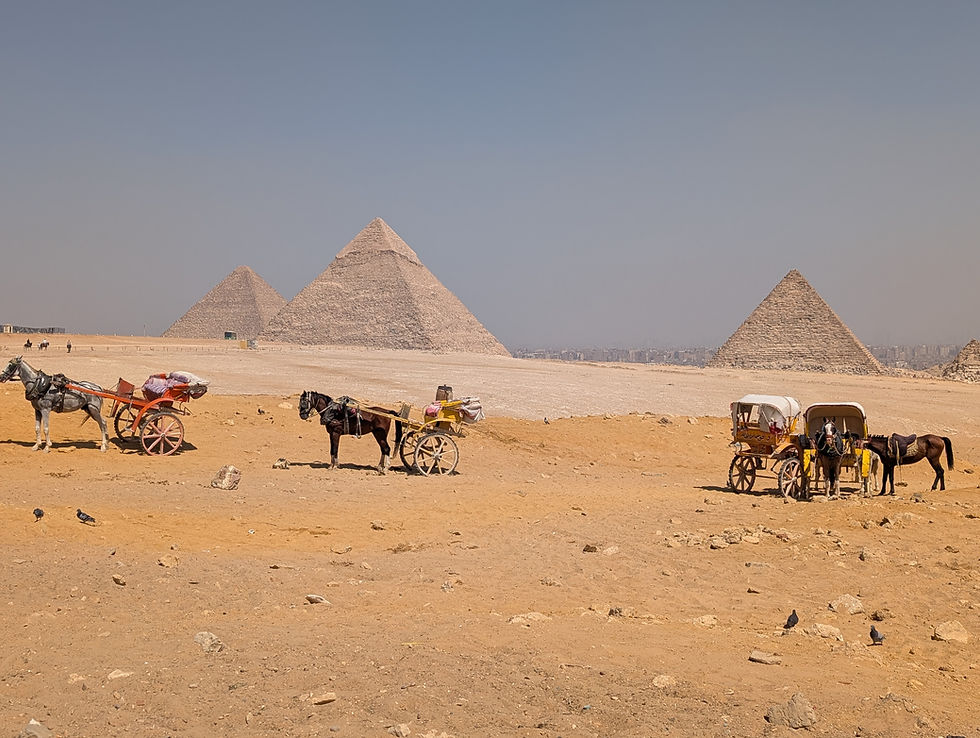
Panoramic Point of the Pyramids Panoramic Point of the Pyramids
On my first visit back in 1989, this area felt wild and open—you could simply wander into the sands without much restriction. I have mixed memories of riding a camel called Michael Jackson (I kid you not!), but there was a moment of horror when MJ started running away from its handler with me on its back, heading into what was an empty expanse of desert (today Giza is much more built up!). During my recent trip, I decided to embrace tradition again and paid for a camel ride from Panoramic Point, launching into the golden desert for some unforgettable views. There’s nothing quite like swaying atop a camel with the pyramids shimmering in the distance—it's one of those quintessential things to do in Egypt that connects you to thousands of years of history while offering a perspective few ever forget. Thankfully, this wild excursion was a lot more controlled.

Tailor-Made Top Tip:
Always agree on the price of a camel ride before you start. Vendors often quote high prices for souvenirs and rides—don’t hesitate to negotiate politely.
The Pyramids of Giza Egypt The Pyramids of Giza Egypt The Pyramids of Giza Egypt
Khufu Pyramid
After taking the shuttle bus down to the Great Pyramid, I stepped out and was immediately struck by its overwhelming presence. Standing so close, it’s almost impossible to capture its sheer size in a photo—the pyramid seems to rise endlessly, dwarfing everything around it. Walking along its base, I felt like I was tracing the edge of a stone mountain, each block massive and weathered by time.

Khufu, also known as Cheops, was the second pharaoh of Egypt’s Fourth Dynasty and the visionary behind this monumental structure. His reign marked a period of immense ambition and architectural innovation, with the Great Pyramid serving as his eternal resting place and a symbol of absolute power.
Khufu Pyramid Khufu Pyramid Khufu Pyramid
From this vantage point, you truly appreciate the audacity of Khufu’s vision—a monument built not just for a king, but for eternity.

Inside Egyptian Pyramids
The entrance to the Great Pyramid is reached via a short flight of steps cut into the stone leading up to the opening on the north face. From there, the adventure begins. Walk along a narrow passage, then ascend the first set of dramatic stairs. This is quickly followed by a second set of stairs climbing steeply into the pyramid’s core. At the top of the stairs, I then had to crawl through a narrow passage on hands and knees—6 foot tall can be challenging sometimes! The air inside the passage is hot and heavy, however, the air-conditioning fans in the burial chamber offer some relief.

Great Pyramid Great Pyramid Great Pyramid
Finally, you reach the King’s Chamber, a stark granite room that still holds Khufu’s empty sarcophagus. Standing there, surrounded by massive stone blocks, you feel the weight of history pressing in from all sides. It’s incredible to think these passages were carved over 4,500 years ago using simple tools and human determination. Experiencing the interior is truly one of the best of Egypt adventures for those willing to make the climb.

Other pyramids also allow entry and rank among the most fascinating places to see in Egypt. The Pyramid of Khafre has internal passages leading to its burial chamber, and the Pyramid of Menkaure offers a shorter, less demanding route. For the adventurous, the Bent Pyramid at Dahshur is, I understand, another fascinating climb, with steep shafts and unique angles that make it a favourite for those seeking something different.
King’s Chamber, Great Pyramid King’s Chamber, Great Pyramid King’s Chamber, Great Pyramid
If you are enjoying this list, remember and subscribe to my mailing list to receive my latest blog posts.
The Sphinx
Standing guard over the Giza Plateau like a silent sentinel, the Great Sphinx is one of Egypt’s most enigmatic monuments. Carved directly from the limestone bedrock, this colossal statue combines the body of a lion with the head of a human. Measuring about 73 meters long and 20 meters high, it’s the largest monolithic statue in the world and a masterpiece of ancient craftsmanship.

The Sphinx’s origins are shrouded in debate. Most Egyptologists date it to around 2500 BCE, during Khafre’s reign, but alternative theories abound. Some researchers argue it could be far older, citing erosion patterns that suggest prolonged exposure to water—fuelling speculation of a pre-dynastic origin. Others believe it may have been re-carved from an earlier structure. These conflicting theories only add to its allure, making the Sphinx not just a monument, but a riddle carved in stone.

Directly in front of the statue lies the Sphinx Temple, an often-overlooked gem of the Giza complex. Built from massive limestone blocks, this temple is thought to have been part of a larger ceremonial complex linked to Khafre’s pyramid. Its design includes two courtyards and remnants of granite pillars, suggesting it played a role in solar worship or ritual offerings.
Visiting the Sphinx today is a very different experience from the chaotic scene I remember in 1989, when you could wander right up to its paws. Now, the area is carefully managed, with viewing platforms offering excellent photo opportunities without damaging the site. Look closely and you’ll notice the famous missing nose—a mystery in itself—and remnants of ancient paint that hint at its once vibrant appearance.
The Sphinx Temple at The Pyramids of Giza Egypt The Sphinx Temple at The Pyramids of Giza Egypt The Sphinx Temple at The Pyramids of Giza Egypt
Tailor-Made Top Tip:
Arrive early if you want a clear shot of the Sphinx without crowds. The morning light is perfect for photography, casting soft shadows that highlight its majestic features.
There is an entertaining Sound and Light Show held in front of the Sphinx and the pyramids. As night falls, the monuments are bathed in vibrant colours while a dramatic narration tells the story of ancient Egypt—often as if the Sphinx itself is speaking. However, check which language the show will be performed in before you book. On my first visit, I didn’t… and ended up at the French version. Oh là là, what a mistake!
The Facilities at Giza
The modernized Giza complex is designed to make your visit comfortable and convenient. Shuttle buses run regularly between the main entrance, the pyramids, and the Sphinx, saving you from long walks under the desert sun. There are cafés and snack kiosks for food and drink, plus shaded seating areas where you can take a break. Clean toilets are available at key points, and you’ll find gift shops selling souvenirs, books, and replicas near the Visitor Centre and major stops. Everything is well signposted, making it easy to navigate even on a busy day.

Tailor-Made Top Tip:
The gift shops are excellent, with a good selection of items. However, I found that these tended to be a lot more expensive than regular gift shops. If you are not struggling for time, hold off from purchasing your gifts.
I found the toilet facilities that I used to be well maintained and clean, but, as a general rule for your Egyptian visit, make sure to bring your own tissue or flushable wipes.
The Pyramids of Giza Egypt The Pyramids of Giza Egypt The Pyramids of Giza Egypt
Where are the Pyramids?
The Pyramids of Giza sit on the Giza Plateau, about 13 kilometres (as the crow flies) southwest of central Cairo. Despite their desert setting, they’re surprisingly close to the city—so close that you can often see the skyline in the distance. The main entrance to the pyramid complex is now through the Great Gate, located along the Cairo–Fayoum road. This modern gateway leads into the Visitor Centre, where you’ll find ticket kiosks, security screening, and shuttle buses to the pyramids and the Sphinx.
There are several ways to reach Giza from Cairo:
Taxi or Ride-Hailing Apps: The most convenient option. Agree on the fare or use apps like Uber or Careem to avoid haggling.
Private Tours & Organized Day Trips: Many operators offer hotel pickup and guided visits, Ideal if you want a hassle-free experience with transport, tickets, and a guide included.
Public Transport: Budget travellers can take the metro to Giza Station, then a short taxi ride to the entrance.
The Pyramids of Giza Egypt The Pyramids of Giza Egypt The Pyramids of Giza Egypt
Tailor-Made Top Tip:
Traffic in Cairo can be unpredictable, so allow extra time for the journey—especially if you’re visiting in the morning when roads are busiest.
If you’re planning to catch the Sound and Light Show in the evening, consider arranging a return transfer in advance. Taxis can be scarce after dark.
Quick Questions Answered
How many pyramids are there in Egypt? Egypt has around 118–138 identified pyramids, built mainly during the Old and Middle Kingdoms as tombs for pharaohs and queens. While the three pyramids at Giza are the most famous, others can be found at sites like Saqqara, Dahshur, Meidum, and Lisht.
When were the pyramids of Giza built? The three pyramids at Giza were constructed during Egypt’s Fourth Dynasty, around 2600–2500 BCE. The Great Pyramid of Khufu is the oldest and largest, followed by Khafre’s pyramid and then Menkaure’s.
When was the first pyramid built? The first pyramid in Egypt was the Step Pyramid of Djoser at Saqqara (near Giza), constructed during the Third Dynasty around 2667–2648 BCE. Designed by the architect Imhotep, it marked a revolutionary shift from traditional mastaba tombs to monumental stone structures.
Does Giza have the biggest pyramids in the world? Yes. The Great Pyramid of Khufu at Giza is the largest pyramid ever built. It held the title of the tallest man-made structure in the world for nearly 4,000 years.
How many pyramids are there in the world? There are hundreds of pyramids worldwide, built by different civilizations. In addition to Egypt, others exist in Sudan (which actually has more pyramids than Egypt), Mexico, Peru, and even China. Each culture developed its own style and purpose, from royal tombs to ceremonial temples.
The Pyramids of Giza Egypt The Pyramids of Giza Egypt The Pyramids of Giza Egypt
What are the pyramids made of? Most pyramids were built from limestone blocks, with higher-quality Tura limestone used for the outer casing to give a smooth, gleaming finish. The cores often contained local limestone, while the burial chambers were lined with granite, especially in the Great Pyramid. Some pyramids also feature basalt flooring and mudbrick in later structures.
What were the dimensions of the pyramids and how tall is the pyramid of Giza? The Great Pyramid of Khufu originally stood at about 146 meters (479 feet) high with a base of 230 meters (755 feet) on each side. Today, due to erosion and loss of casing stones, it measures around 138 meters (454 feet). Khafre’s pyramid is slightly smaller at 136 meters (446 feet), and Menkaure’s is much smaller at about 65 meters (213 feet) in height.
What are the names of Giza’s pyramids? The three main pyramids at Giza are:
The Great Pyramid of Khufu (Cheops) – the largest and oldest.
The Pyramid of Khafre (Chephren) – slightly smaller, with some casing stones still visible at the top.
The Pyramid of Menkaure – the smallest of the trio, notable for its granite base.
How far are the pyramids from Cairo? The Pyramids of Giza are about 13 kilometres (8 miles) southwest of central Cairo, roughly a 30–45-minute drive depending on traffic.
How to purchase your pyramids of Giza tickets? Tickets can be bought at the Visitor Centre kiosks at the Great Gate entrance. Payment is usually accepted in Egyptian pounds, and while card machines are available, carrying cash can save time if systems are slow. Prices vary depending on whether you want general entry or access to specific pyramids like Khufu’s interior. Tickets for the official Sound and Light Show can be booked online.
What is the best time to visit the pyramids? The best time to visit the Pyramids of Giza is early in the morning, ideally between 8:00 AM and 10:00 AM, when temperatures are cooler and crowds are smaller. Avoid midday heat, especially in summer, as the plateau offers little shade. Late afternoon can also be pleasant for photography, with softer light and fewer visitors.

The Sphinx
Conclusion
Standing before the Pyramids of Giza Egypt, one of the most famous places in Egypt, never gets old—literally and figuratively. These ancient monuments have endured for over 4,500 years, and whether you're visiting for the first time or returning decades later like I did, they still have the power to stop you in your tracks. From the precision engineering of the great pyramid of Giza to the enigmatic gaze of the Sphinx, every corner of the Giza pyramids complex tells a story of human ambition, ingenuity, and an unshakeable belief in eternity.
The site has changed dramatically since my first visit in 1989—today's experience is more organized, accessible, and visitor-friendly, with modern facilities that make exploring easier without diminishing the magic. Whether you choose to climb inside Khufu's shadowy passages, ride a camel across the golden sands at Panoramic Point, or simply sit quietly watching the sun set behind these colossal structures, you'll leave with memories that last a lifetime and a profound connection to one of humanity's greatest achievements.
Hotels in Cairo near The Pyramids of Giza
If you want to wake up to views of the ancient wonders, there are some fantastic hotels just steps from the Giza Plateau that combine comfort with unforgettable scenery.
Marriott Mena House
The Marriott Mena House offers stunning pyramid views from its lush gardens and many rooms. This 5-star hotel features a large swimming pool, spa, fitness centre, and beautifully landscaped grounds. Breakfast in the garden with the pyramids as your backdrop is an unforgettable experience. It’s less than half a mile from the main entrance, making it ideal for early visits or catching the evening Sound and Light Show.
Sofitel Cairo Downtown Nile
👉 Although in Cairo city centre, I stayed here during my trip and can personally recommend it for its comfort, service, and unbeatable location.
This hotel blends French elegance with Egyptian charm, offering sweeping views of the Nile from stylish rooms and suites. Located in the heart of Cairo near Tahrir Square and the Egyptian Museum, this 5-star hotel features world-class dining, a serene spa, and an outdoor pool overlooking the river—perfect for travellers seeking luxury and culture in one unforgettable stay.
Sofitel Cairo Downtown Nile Sofitel Cairo Downtown Nile Sofitel Cairo Downtown Nile Sofitel Cairo Downtown Nile
Related Blog Posts
If you would like more information on other incredible sights in Cairo and Egypt and how to visit these locations, please view the Tailor-Made Itineraries posts below:

Have you visited the Pyramids of Giza, or are you planning your trip? I'd love to hear about your experiences, questions, or travel tips—leave a comment below and let's keep the conversation going!
Don’t forget that Tailor-Made Itineraries delights in creating bespoke self-guided tours. So, if visiting the Pyramids of Giza Egypt appeals to you, reach out to me by email. I would be more than happy to design a self-guided tour around your requirements incorporating the pyramids, or indeed, a general tour of things to see in Cairo.
Tailor-Made Itineraries posts every two weeks, and you can subscribe to the latest blog and newsletter here. Until then, happy reading and safe travels.
Barry
Contact Me: tailoritineraries@gmail.com
Tailor-Made Itineraries create one-of-a-kind bespoke self-guided travel itineraries for adventurous and curious travellers.
These self-guided tours deliver a personalised and exciting holiday experience that takes the effort out of trip planning.


Comments